Plant spacing calculator — how far apart to plant vegetables
Use the square-foot gardening method to know exactly how many plants fit in your raised bed — no row-measuring required.
Plant spacing is not one universal number — it depends on the crop's mature size. The easiest system for raised beds is square-foot gardening (SFG): divide the bed into 30 cm × 30 cm (1 ft × 1 ft) squares, then fit a fixed number of plants per square based on the crop. Tomatoes need a full square each; carrots fit 16 per square.
How square-foot gardening spacing works
Traditional row gardening was designed for tractors: wide paths between rows, thin planting within. Raised beds change the equation. You tend them from the sides, the soil is deep and amended, and plants can fill space in every direction — not just along a row.
Square-foot gardening was codified by Mel Bartholomew in the 1970s and is the most widely used method for raised beds today. The grid forces you to commit to a number before planting, which prevents the most common beginner mistake: over-planting large crops in too small a space.
The plants-per-square counts below are the standard SFG recommendations, appropriate for deep, well-amended raised-bed soil. If your soil is compacted or poorly drained, give larger plants a little extra room.
SFG spacing reference table
Each row shows the number of plants that fit in one 30 cm × 30 cm (1 ft²) square.
| Plants per square | Count | In-row spacing (traditional) |
|---|---|---|
| Tomato, Pepper, Eggplant, Broccoli, Cabbage, Cauliflower | 1 | 45–60 cm / 18–24 in between plants; 90–120 cm / 36–48 in between rows |
| Cucumber (trellised), Swiss chard | 2 | 30–45 cm / 12–18 in between plants |
| Lettuce, Garlic, Strawberry, Basil | 4 | 15–20 cm / 6–8 in between plants |
| Bush beans, Beets, Spinach, Onions | 9 | 10–15 cm / 4–6 in between plants |
| Carrots, Radishes | 16 | Carrots: thin to ~5 cm / 2 in; Radishes: ~3 cm / 1.5 in |
Notes on a few common crops
Tomatoes: In a raised bed, 1 per square (1 ft²) is correct — but most varieties need a cage or a trellis to keep them off the bed surface. Indeterminate varieties will happily spread 60–90 cm (24–36 in) wide, so plan the neighbouring squares accordingly.
Carrots: 16 per square (a 4×4 grid) assumes a deep, stone-free growing medium. In shallower soil, plant finger or Chantenay varieties that don't need 30+ cm of depth.
Cucumbers: Trained vertically on a trellis along the north or east edge of a bed, 2 per square works well and preserves light for shorter neighbours. Bush cucumber varieties can go 2 per square without a trellis, but they sprawl — account for that.
Bush beans: 9 per square assumes bush (determinate) varieties. Pole beans climb; give them a trellis and treat them like cucumbers.
Plant spacing calculator
Pick a crop and enter your bed size — get an instant plant count.

Calculator uses the standard SFG 1 ft² (30 cm × 30 cm) grid. Counts assume deep, amended raised-bed soil.
The calculator answers one square. The app plans all of them.
A single-crop count is a good starting point, but a real raised bed has eight, twelve, or sixteen squares — each with a different crop, different companion requirements, and a different sow-and-harvest window. Keeping that in your head is where over-planting happens.
Raised Bed Planner gives you a square-foot grid for beds of any size. You drag plants from an 87-plant catalog directly onto the squares, and the app shows companion-planting notes for each placement — so you know before planting that basil loves tomatoes but dislikes fennel.
Set your last frost date once and the app calculates exactly when to start each plant indoors or direct-sow outside. When the season ends, log every harvest by weight or count — so next year's plan is based on data, not guesswork.
- 87-plant catalog with companion notes and sow-to-harvest windows
- Frost-date planner: set your date, get exact sow timing per plant
- Harvest log by weight or count, per bed and per plant
- Care reminders and a weekly tasks agenda
- Crop rotation guidance that flags when a plant family returns too soon
- Optional iCloud sync to your own Apple account — nothing else leaves the device
- One-time €4.99, no subscription, no account, full interface in EN / NL / DE / FR
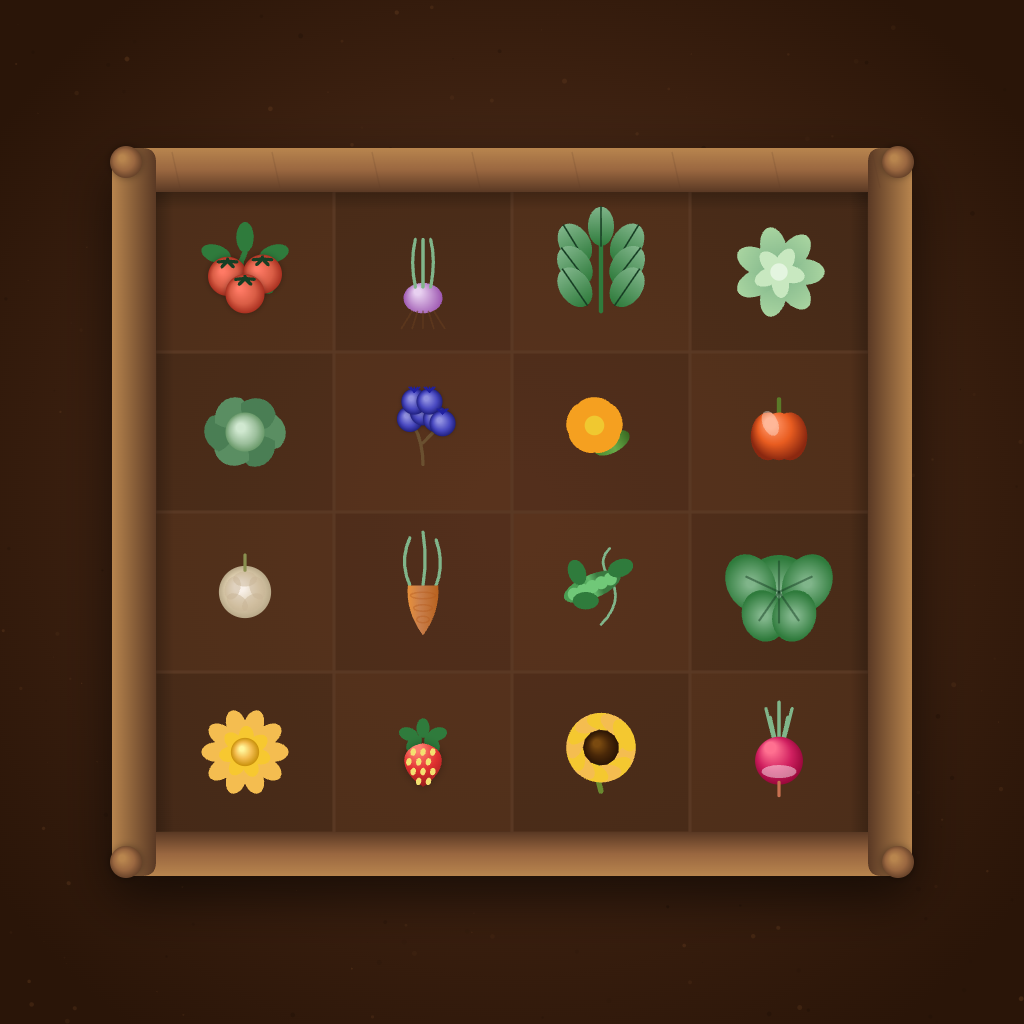
Raised Bed Planner for iPhone
Plan every square of every bed — 87 plants, companion notes, frost dates, harvest log. €4.99 one-time, no account, no subscription.
- No account or signup — open the app and start planting
- No analytics, crash reporters, or tracking SDKs
- iCloud sync goes to your iCloud, not ours — or leave it off entirely
- One-time purchase, no subscription ever
Common questions
How far apart should I plant tomatoes?
In traditional rows, plant tomatoes 45–60 cm (18–24 in) apart, with 90–120 cm (36–48 in) between rows. In a square-foot raised bed, 1 tomato per 30 cm × 30 cm square. Provide a cage or trellis — indeterminate varieties can reach 90 cm wide.
What is square-foot gardening?
Square-foot gardening (SFG) divides a raised bed into 30 cm × 30 cm (1 ft × 1 ft) squares and assigns a fixed number of plants per square based on mature plant size — 1 for large crops like tomatoes, up to 16 for small ones like carrots. It eliminates row-spacing calculations and prevents over-planting.
How many carrots fit in one square foot?
16 carrots per square foot, arranged in a 4×4 grid with roughly 7.5 cm (3 in) between plants. In traditional rows, thin to about 5 cm (2 in) apart in rows 30 cm apart. Use a deep, stone-free growing mix for best results.
Do raised beds need different spacing than in-ground rows?
The SFG counts here assume a deep, amended raised-bed mix where roots can expand in any direction. In compacted or poor-quality in-ground soil, give larger plants a bit more space. The row-spacing figures in this guide apply to conventional in-ground planting.
What is the best layout for a 4×4 raised bed?
A 4 ft × 4 ft bed gives you 16 one-foot squares. A productive summer combination: 1 tomato (1 sq), 2 trellised cucumbers along the back (1 sq), 4 basil (1 sq), 4 lettuce (1 sq), 9 bush beans (1 sq), 9 spinach (1 sq) — that fills 6 squares of productive crops and leaves 10 squares for your own choices. The Raised Bed Planner app will flag companion conflicts automatically.
Plantafstand rekentool — hoever uit elkaar moestuin zaaien
Gebruik de vierkante-meter-methode (SFG) om precies te weten hoeveel planten in je verhoogd bed passen — zonder rijafstanden te meten.
Plantafstand hangt af van de volwassen grootte van het gewas. De eenvoudigste methode voor verhoogde bedden is square-foot gardening (SFG): verdeel het bed in vakken van 30 cm × 30 cm en plant een vast aantal planten per vak. Tomaten krijgen een heel vak, wortels passen met 16 in één vak.
SFG-plantafstand referentietabel
Elk vak staat voor een ruimte van 30 cm × 30 cm (1 vierkante voet).
| Planten per vak | Aantal | Rijafstand (traditioneel) |
|---|---|---|
| Tomaat, Paprika, Aubergine, Broccoli, Kool, Bloemkool | 1 | 45–60 cm tussen planten; 90–120 cm tussen rijen |
| Komkommer (geleid), Snijbiet | 2 | 30–45 cm tussen planten |
| Sla, Knoflook, Aardbei, Basilicum | 4 | 15–20 cm tussen planten |
| Stamslaboon, Rode biet, Spinazie, Ui | 9 | 10–15 cm tussen planten |
| Wortel, Radijs | 16 | Wortel: dunnen tot ~5 cm; Radijs: ~3 cm |
↑ Gebruik de rekentool hierboven om direct het aantal planten voor jouw bed te berekenen.
Veelgeplante gewassen
Tomaten: 1 per vak, plus een stok of klimrek. Onbegrensd groeiende rassen (indeterminaat) kunnen 60–90 cm breed worden — plan de buurvakken mee.
Wortels: 16 per vak in een 4×4-patroon (±7,5 cm tussenruimte). Gebruik een diepe, steenvrije potgrond voor rechte, lange wortels.
Komkommers: Langs de noordzijde van het bed op een klimrek, 2 per vak. Struikkomkommers kunnen ook zonder klimrek op 2 per vak, maar ze spreiden.
De rekentool geeft één vak. De app plant ze allemaal.
Een verhoogd bed van 4 bij 8 voet heeft 32 vakken met verschillende gewassen, goede-buren-regels en zaaivensters. Raised Bed Planner beheert die complexiteit voor je: sleep planten uit een catalogus van 87 gewassen op het raster, ontvang goede-buren-waarschuwingen, stel je vorstdatum in voor exacte zaaitijden en registreer elke oogst per gewicht of aantal.
Eenmalig €4,99, geen abonnement, geen account — tuindata blijft op je toestel, met optionele iCloud-sync naar je eigen Apple-account.
Raised Bed Planner voor iPhone
Plan elk vak van elk bed — 87 planten, goede-buren-tips, vorstdatums, oogstlogboek. €4,99 eenmalig, geen account, geen abonnement.

- Geen account of registratie — open de app en begin
- Geen analytics, crashrapporteerders of tracking-SDK's
- iCloud-sync gaat naar jouw iCloud, niet de onze — of laat het gewoon uit
- Eenmalige aankoop, nooit een abonnement